
A Tale of Two Fields
The response to desertification in Spain.

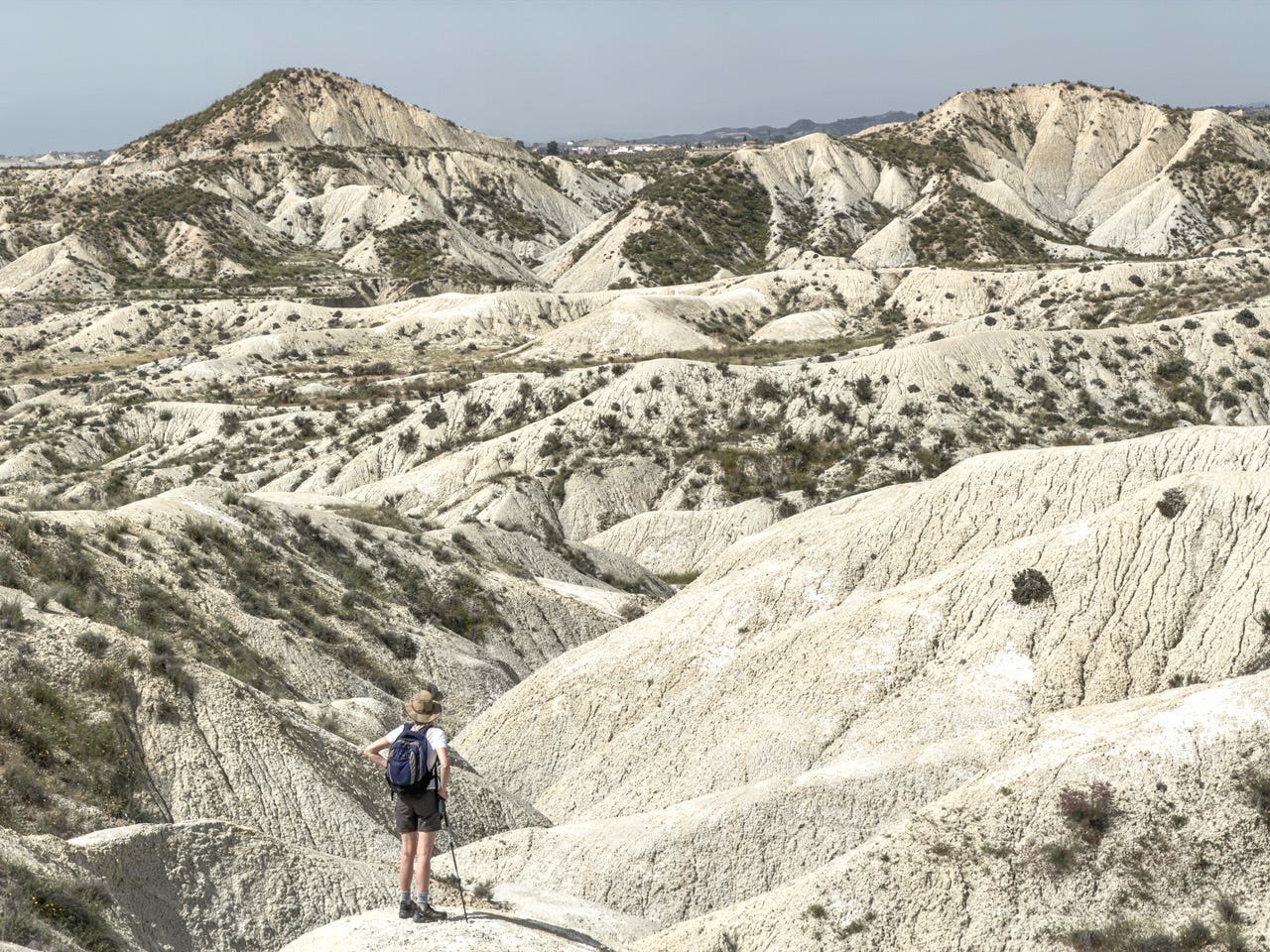
The ‘Badlands’ of Abanilla Desert. Murcia, South-East Spain. All photos © Robert Wallis
Campohermoso. A straggling town you pass through on your way to the beaches of Andalucia, South-East Spain. A dusty settlement of decidedly non-touristy cafes and shops, many of which feel more African than European, where the main selling point for visitors is the easy access out of Campohermoso to the coast just over the hill.
The name Campohermoso, in Spanish, means ‘beautiful fields’. Antonio, a local farmer, can remember the town and its surrounding area when it did, indeed, live up to its name. ‘When I was growing up, until the end of the 1970s, everything here was just fields. We grew vegetables. There were strawberry trees, oaks, donkeys. It was beautiful’, he recalls.
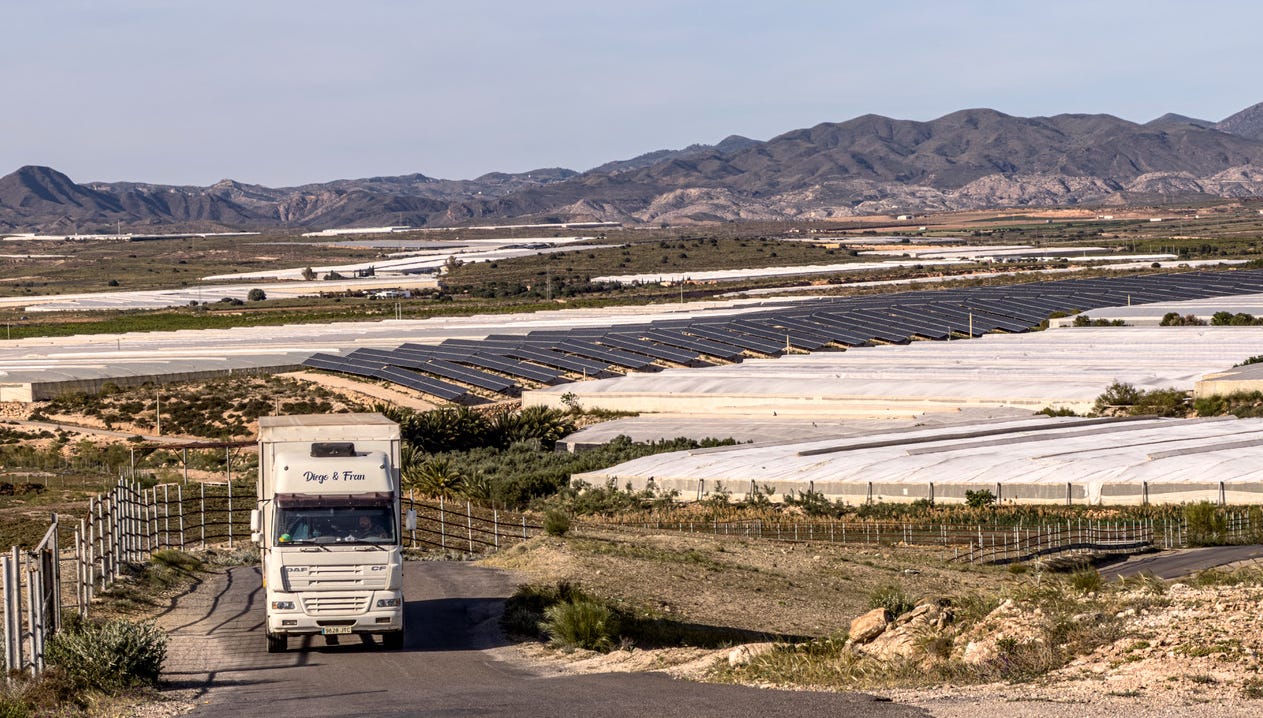
The greenhouses and solar panels. Campohermoso, Almeria, South East Spain.
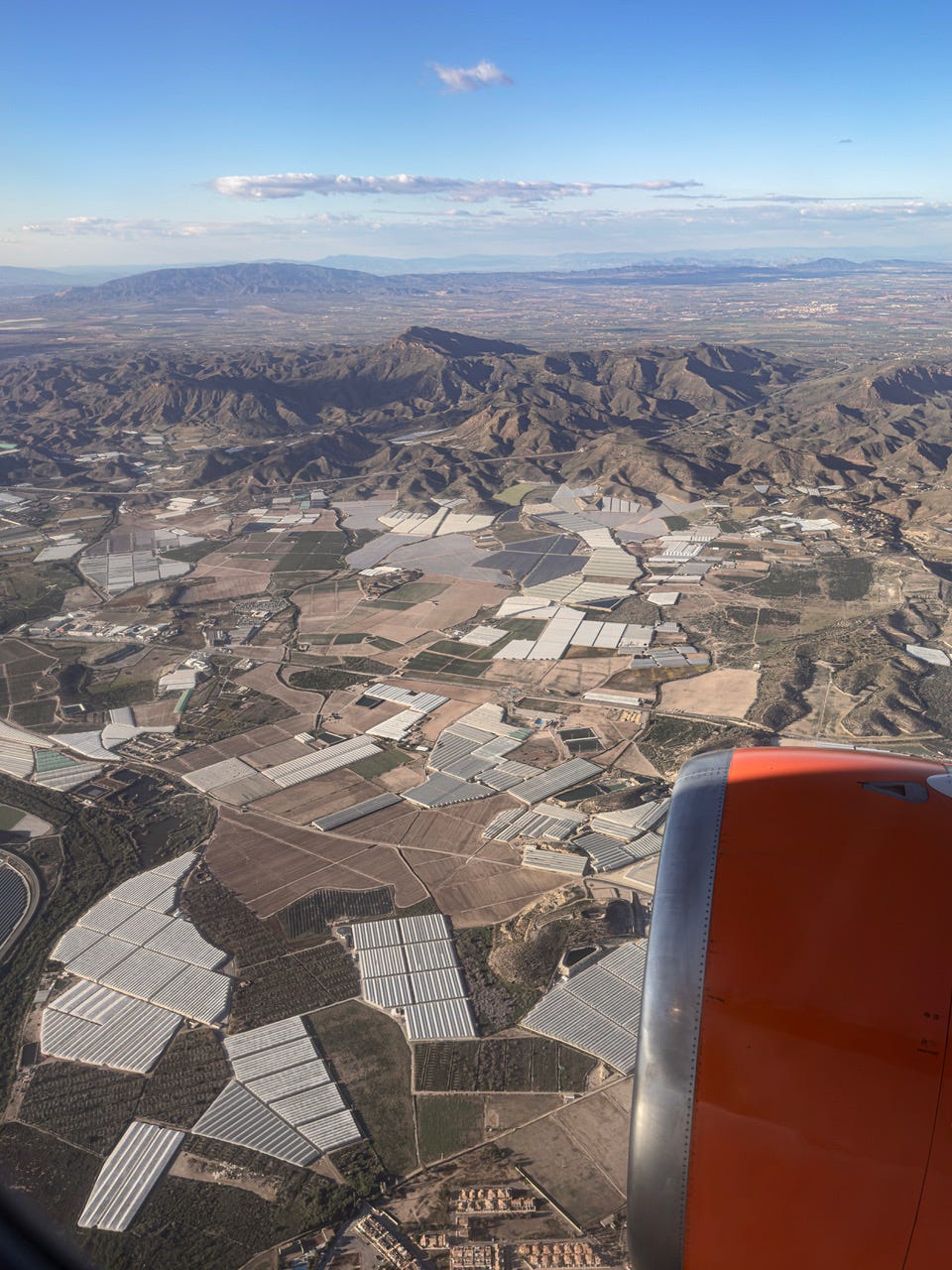
But now it is a valley of plastic. Soft white polythene sheets stretch right across the plain, hothousing the rows of vegetable plants beneath them. Campohermoso has become the centre of Spain’s ‘greenhouse’ boom in recent decades. Across these plastic fields, tomatoes, courgettes, cucumbers, lettuces, aubergines are synthetically forced into flourishing to fulfil our modern insatiable appetite across Europe to eat salad whatever the time of year or the season. 3.5 million tons of vegetables are produced here annually, a third of the total production of Spain and a major boost to the nation’s economy. From a distance, the stretched plastic sheets look like water glinting in the intense Andalucian sun, a new kind of desert mirage. Migrant workers employed in these stifling greenhouses, mostly from north or sub-Saharan Africa, travel back to their digs in the evenings on electric scooters, scarves wrapped around their faces to protect them from the heat and the dust.
Sixteen miles up the road is a very different ‘field’, an alternative response to the challenges of growing food in the changing climate of southern Spain. Sunseed Desert Technologies, originally a sustainable living charity founded by British scientists, has created a green oasis in a parched landscape. On small terraces sculpted out of the small canyon created by the Rio Aguas, they have made a trial over the last four decades of planting a diversity of crops that suit the landscape and the climate and that are expected to ripen at the right time. They use no pesticides, no fertilisers, no harmful chemicals of any kind, and all water and energy is naturally produced and carefully conserved. The latest experiment is with ‘syntropic gardening’, a form of agriculture which takes its inspiration from forests in which diverse plants work together in their own ecosystem. It becomes a little ‘food forest’, Estrella Bastante Pain, passionately committed Sunseed staff member, tells us.
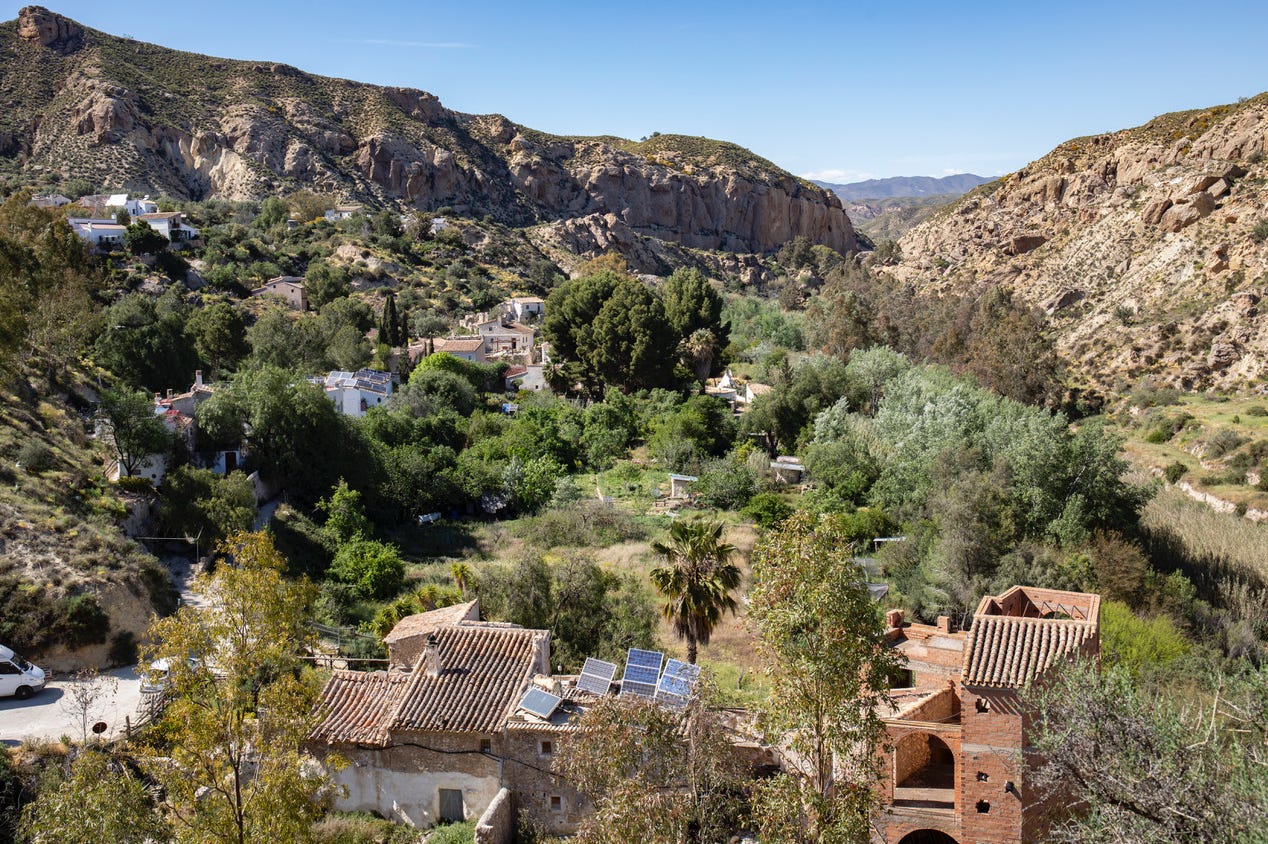
Sunseed Desert Technologies, Los Molinas de Rio Aguas, near Sorbas, Almeria.
Southeast Spain – the regions of Almeria and Murcia in particular – are at the frontline of desertification in Europe. The average temperature in the summer months is 30º Celsius and annual rainfall no more than around 200 mm (less than 8 inches), the lowest in Europe. Every year the weather gets hotter and drier, with summer temperatures regularly exceeding 45º, and the subterranean aquifers run lower and more saline. While I was in Spain last month, there was an emergency meeting held to discuss the aquifer under the agricultural village of Lucainena, near Sorbas, between Sunseed and Campohermoso. The groundwater there, beneath the fields of olive trees and other intensive monoculture farming, has virtually run dry.
There were always deserts in Southeast Spain. Lorca’s play Blood Wedding (1932) was inspired by the true, melodramatic story of love and murder that happened on a dusty, arid farm between Campohermoso and Rodalquilar. The tragic play is driven by the striking images of the parched land longing irrigation, a not-so-subtle metaphor for the bride’s sexual desire for her secret lover. A little more recently, the desert of Tabernas, about 40 miles northeast of Campohermoso, was the chosen location for Sergio Leone’s Spaghetti Western films. A Fistful of Dollars (1964), The Good, the Bad and the Ugly (1966) and many lesser flicks since (anyone heard of Scalps (1987)? No, I hadn’t either) shot their scenes of ne-er-do-wells in bone-dry Badlands not in the Wild West but in the rocky canyons and dusty salt plains of Almeria. Even today the desert is exploited commercially, with tourists offered the chance to visit the Spaghetti Western movie sets and watch actors staging shoot-outs between tequila shots in the traditional saloon bar.
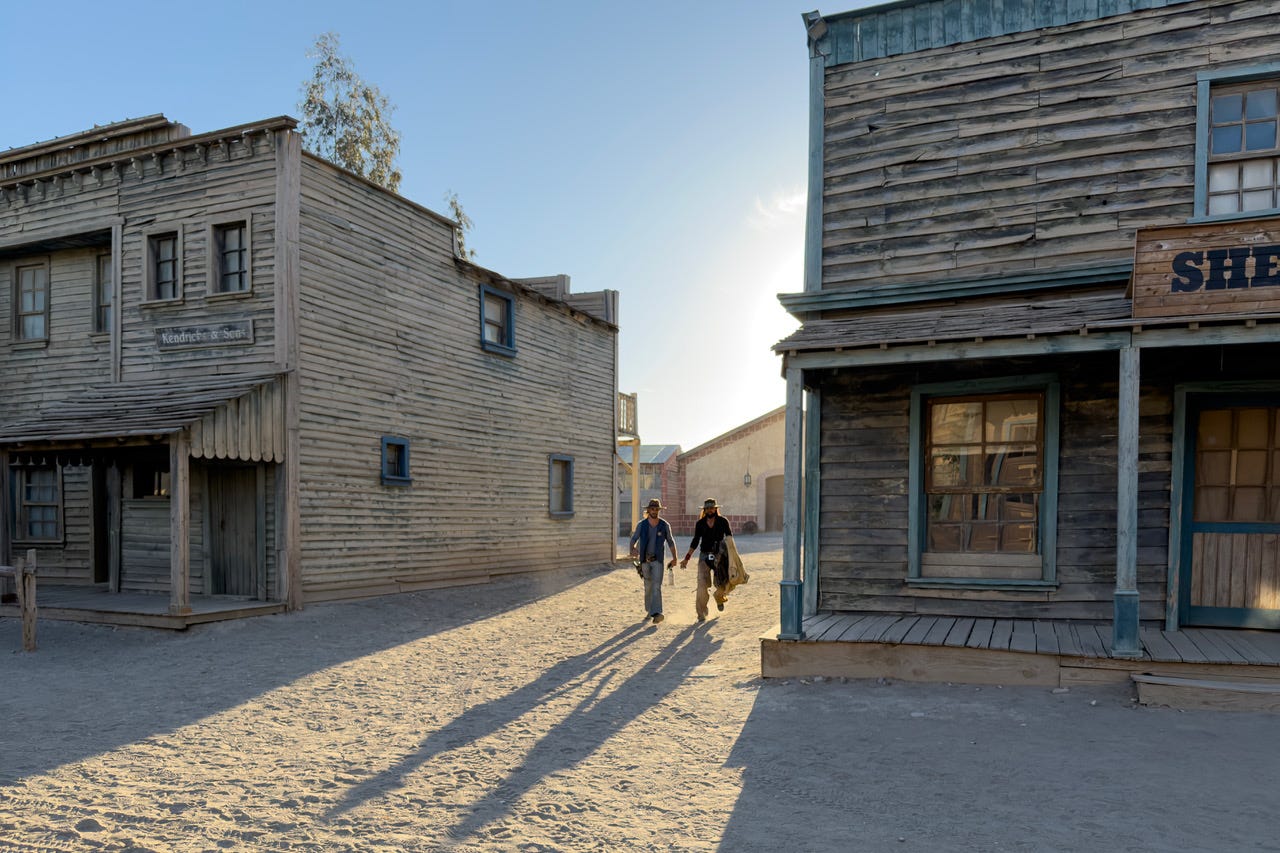
Two actors at Fort Bravo film set. Tabernas Desert, Almeria.
Yes, the desert has its romanticised history but the reality in southern Spain is looking bleak. The greenhouses that protect crops from the desert sun have allowed the growing of a greater diversity of water-sucking, highly profitable vegetables and fruit (tomatoes, cucumbers, melons) which, farmed intensively, are draining the aquifer. The Sorbas aquifer is currently being exploited at four times the rate it can be replenished by rainfall. And the plastic waste from the ‘greenhouses’ quickly becomes microplastic dust, infiltrating everything.
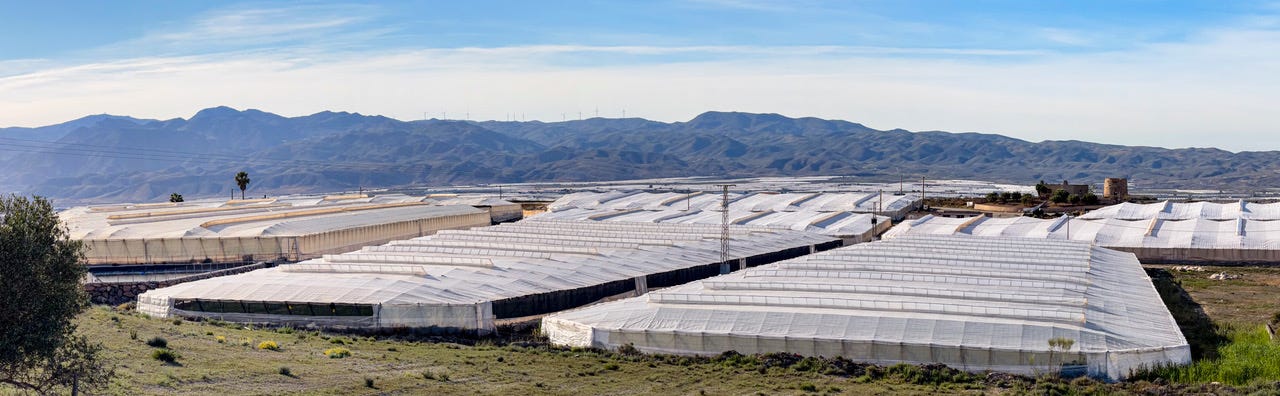
The valley of greenhouses, Campohermoso.
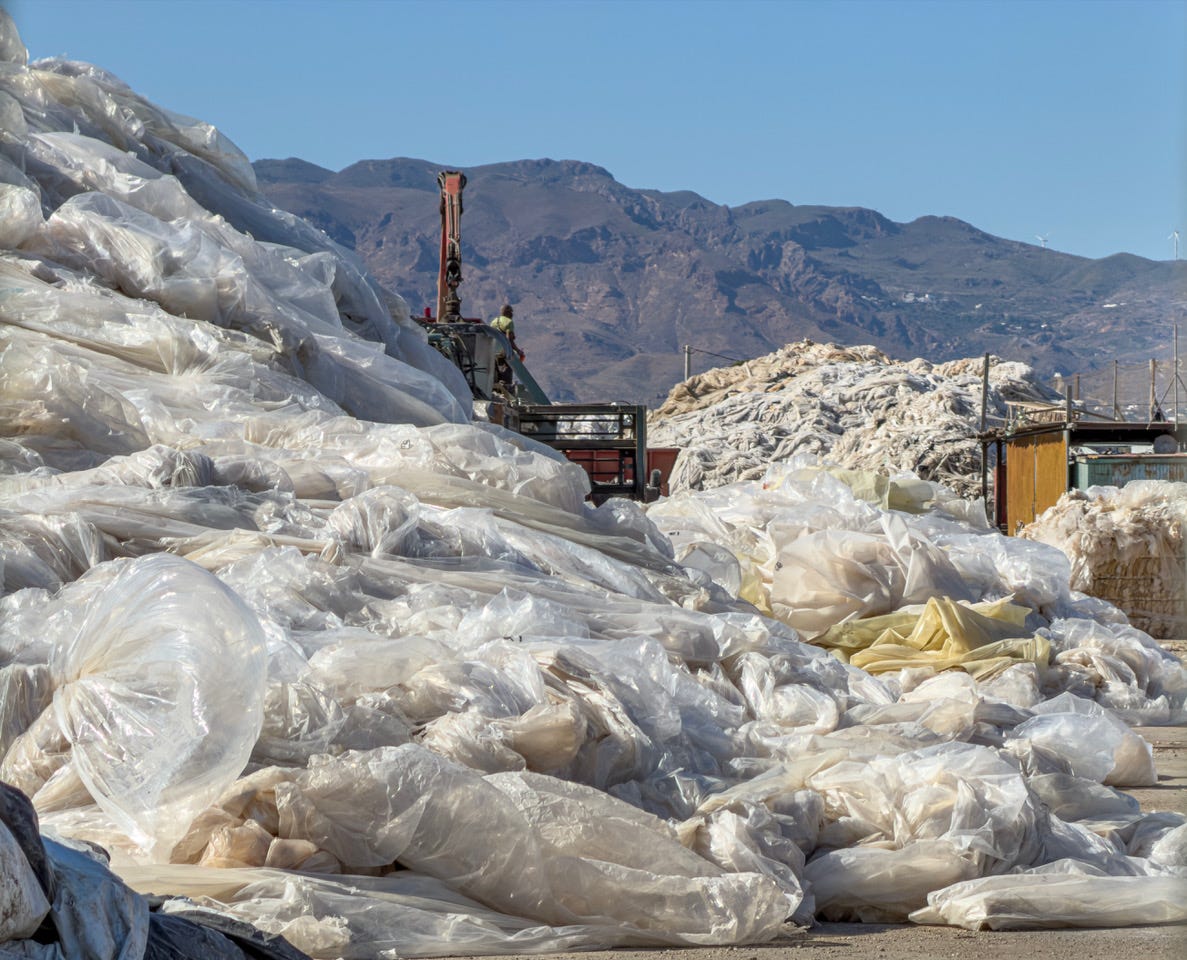
Dealing with the plastic waste beside the greenhouses in Campohermoso.
Even the solutions only lead to more problems. Olive groves, which are planted as intensive monocultures, drawing upon unsustainable groundwater supplies, are now being dug up to make way for massive solar farms. The situation is complicated. Solar farms at scale are an important factor in the pivot to renewable energy and the European Union’s goal of achieving a ‘Net Zero carbon emissions’ economy by 2050. But they are also locally destructive, causing soil degradation, wildlife loss and the chopping down of trees, which of course help to store carbon. Susan, an Australian hippy living in the village of Lucainena, told me that the fields all around her used to be full of olives but now ‘they have bulldozed the lot’. ‘This place used to be busy with tourists. But now nobody comes anymore. Everything is closed’, she continued. ‘The village is becoming deserted because tourists don’t want to come and look at solar farms. It’s not as picturesque’. She added that solar farms don’t offer local employment, despite what was promised by the village mayor.
Meanwhile at Sunseed, the microclimate produced by the abundance and diversity of trees they have planted means the summers are less intense and the water and carbon stay in the soil. But the utopia is tiny. How do you re-create that oasis at scale? The community is committed to outreach and education but still it’s challenging trying to convince large agricultural companies to overturn their business model. Plus, the Sunseed approach comes with considerable personal sacrifice. Volunteers at the community have to give up meat, refrigerated food, any soaps or cosmetics containing chemicals, limitless access to tap water. And the compost toilets, which feature prominently in the visitor tour and clearly in the initiation of any summer intern, require more discomforts and active servicing than most of the public would tolerate.
Yes, tackling the future of climate change in Europe, where southern Spain stands on the frontline, is going to need some serious lifestyle changes as well as technological revolutions. ‘Climate change denial is the main problem’, Berta Navarro, a Sunseed volunteer in her 20s from Valencia told me, as we tucked into a delicious vegan lunch. ‘We should be doing more activism’. Friends and family suggested to her that she should be getting on with her career, instead of spending months at Sunseed. It would be the safer option. ‘What is safety? Capitalism is safety but what about other kinds of safety? Community is safety. 40 years from now, there might not be any safety anymore. We have to re-think completely what we are doing. Who knows that the world will be like in 40 years?’
Thanks, Jennifer! I hadn't realised any of this. Very thought provoking.